
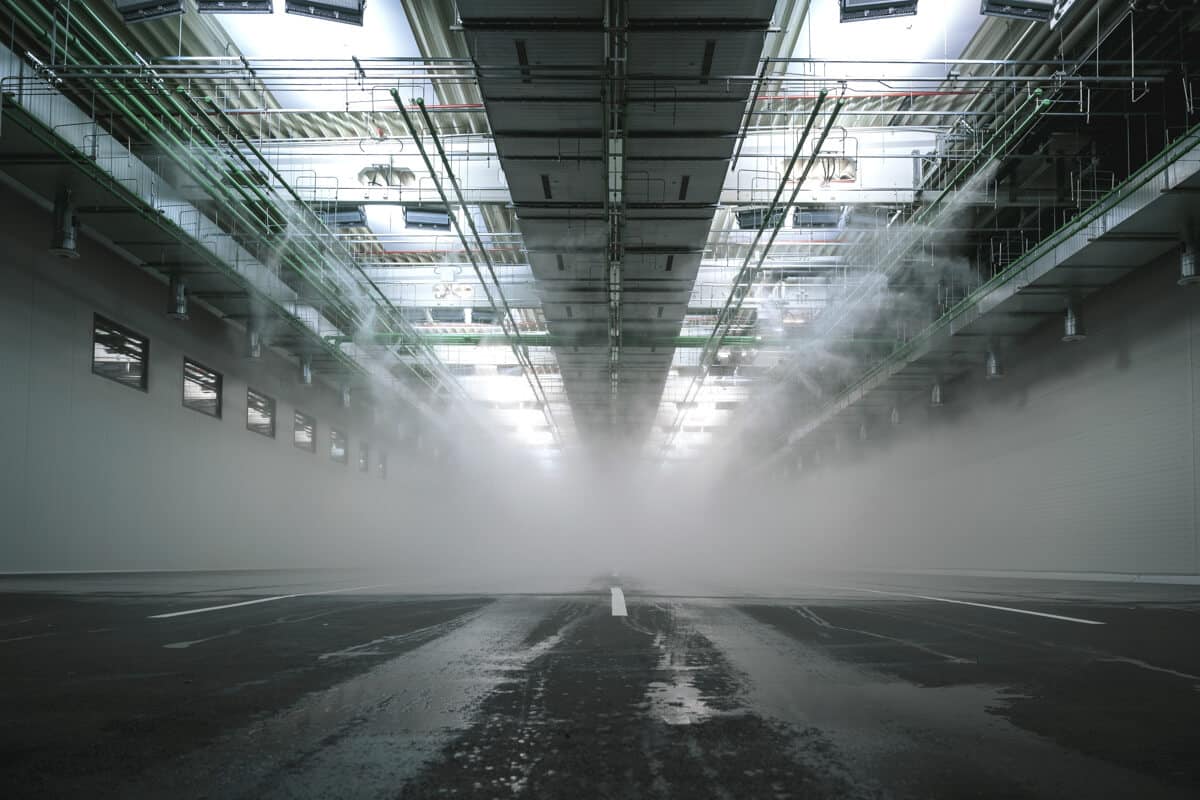
AD Approved – Autonomous Driving Sensor Homologation Lab
ADApproved aims to establish a fully automated and validated test chain for advanced driver assistance and automated driving systems. The project combines physical test infrastructure with virtual components to create an integrated and scalable testing framework.
The core objective is to improve the quality, reproducibility, and certification readiness of indoor hall tests.
Technical Approach
1. Automated and Validated Test Chain
A central element of the project is the development of an end-to-end automated test chain. This includes:
- Integration of simulation tools and sensor-based measurement systems
- Automated test execution and data acquisition
- Standardized and repeatable test evaluation procedures
Automation ensures high repeatability and traceability of results. This is essential for reliable validation and future certification processes.
2. Expansion of the Indoor Test Field
The existing indoor test field is being expanded and digitally enhanced. Virtual components are added in the form of a Digital Twin.
The Digital Twin provides environmental information that cannot be physically reproduced inside the test hall. This includes modeled environmental influences that are critical for realistic scenario testing.
By linking real-world measurements with virtual environmental data, the project creates a hybrid testing environment that combines the strengths of physical and simulation-based validation.
3. Integration of Spray Modeling
Another key research area is the modeling and integration of spray phenomena into the indoor test environment. Spray effects significantly influence sensor performance and perception systems.
By incorporating validated spray models into both simulation and hall testing, ADApproved increases the realism and robustness of sensor validation procedures.
Project Results
The project delivers the following key outcomes:
(1) Digital Twin: Continuous enhancement through automated measurement data acquisition from the physical test field.
(2) Simulation: Integration of modeled environmental influences into existing frameworks to increase realism.
(3) Standardization: Development of repeatable indoor test scenarios with defined Key Performance Indicators (KPIs) for evaluation.
(4) Validation: Creation of a practical, industry-oriented methodology suitable for real-world implementation.
These results support reliable system validation under controlled yet realistic conditions.
The Role of SETLabs
Project Coordination and Advanced AI Weather Modeling
SETLabs was in charge of the overall coordination of the entire project. This also included alignment with the corresponding funding bodies. In addition, SETLabs worked on AI model development with a special focus on rain effects modeling and adverse weather, as well as simulation tasks and model validation.
With the help of AI-based functions, safe.trAIn enables driverless train operation with the aim of safe, economical and comfortable regional transport.


Funded by the „Bayerische Staatsministerium für Wirtschaft, Landesentwicklung und Energie“ within the framework of the Bavarian collaborative research program (BayVFP) in the funding line „Digitalisierung”, Förderbereich „Informations- und Kommunikationstechnik (IuK)”.
Supported by Bayern Innovativ – Bayerische Gesellschaft für Innotvion und Wissenstransfer mbH