

UPSIM – Unleash Potentials in Simulation
Most major industrial organizations rely on numerical simulation across the product lifecycle, yet simulation alone had ceased to be a competitive differentiator. As real testing of increasingly complex smart systems became temporally, practically, and economically infeasible, UPSIM addressed the core challenge of Modelling & Simulation credibility to unlock the full potential of simulation.
The project delivered Credible Digital Twins with predictive capabilities, tackling the fact that less than 1% of physical assets had been modelled to truly capture and mimic behaviour. This opened pathways toward virtual commissioning and predictive maintenance.
UPSIM established Simulation Governance through reference processes and a Digital-Twin Readiness Level metric, AI-enriched Hybrid Simulations ensuring simulation–reality convergence, and infrastructure for chained identification of Digital Twin artefacts.
All major outcomes were released via open access and open source repositories, fostering sustainability and broad market uptake. As a Pan-European innovation action, the project united partners from seven countries and implemented results across agriculture, healthcare, automotive, and smart building value chains.
You are currently viewing a placeholder content from YouTube. To access the actual content, click the button below. Please note that doing so will share data with third-party providers.
Automotive Use Case: Scenario-based Testing
Testing Advanced Driver Assistance Systems (ADAS) is challenging, as the environmental conditions that appear in reality are manifold and complex. Testing on the road only is not feasible since it is expensive and difficult to reproduce results – additionally virtual tests based on environment simulations are therefore required.
These simulations are based on scenarios representing real world situations that provide ground truth data to sensors or sensor models for the environmental perception. To integrate environment simulations with function simulations, lists of objects (i.e. sensed and abstracted traffic participants) and sensor raw data need to be exchanged and have to be processed by the ADAS function under test. Various simulators for automated driving exist that provide different, not uniquely defined interfaces.
The challenge lies in the proper integration and configuration of complex tool-chains for scenario-based testing of (partly) automated vehicles.

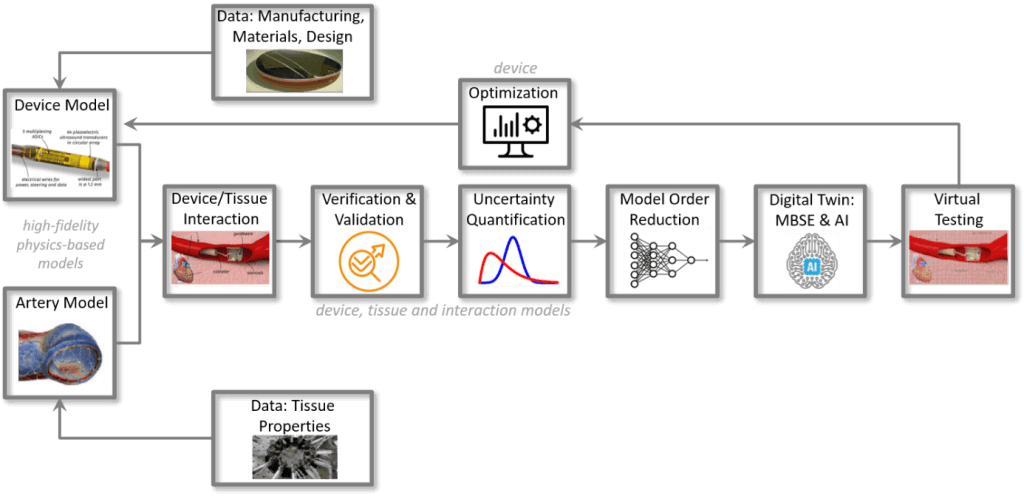
Healthcare Use Case: Medical Imaging Catheter
Virtual Design and Testing of medical imaging catheters by means of creating interacting device/human Digital Twins. To decrease the time to market for next generation medical devices, product development should be strongly supported by virtual design and testing by means of high-fidelity digital twins of these devices and human tissue (e.g., arteries).
Our improved understanding of the device-human tissue interaction from these interacting digital models will lead to quantified loading conditions within the device, and consequently, to improved performance and reliability.
In addition, we will be able to develop accelerated qualification tests and thus, reduce development cycles and materials usage. The use case will lead to quantification of credibility and accuracy of these interacting digital twins for virtual testing, as well as potential workflow and business value.
The ITEA3 UPSIM Project N°19006 has been made possible by the financial contribution from national funding agencies from Germany, Netherlands, Austria, Denmark, Romania.

