
Situational Awareness for Autonomous Robots in Hospitals
Hospitals are highly dynamic environments in which medical staff, patients, visitors, and mobile equipment continuously interact. Autonomous mobile robots supporting clinical workflows must therefore operate safely and reliably while navigating crowded corridors, diagnostic areas, and patient rooms. To achieve this, robotic systems require robust perception and situational awareness capabilities that allow them to understand their surroundings and react appropriately in real time.
The STEWARINA project focuses on enhancing the perception capabilities of mobile robots in healthcare environments. By combining AI-based object recognition, contextual scene understanding, and simulation-driven training approaches, the project aims to enable safer and more reliable autonomous operation in hospitals.
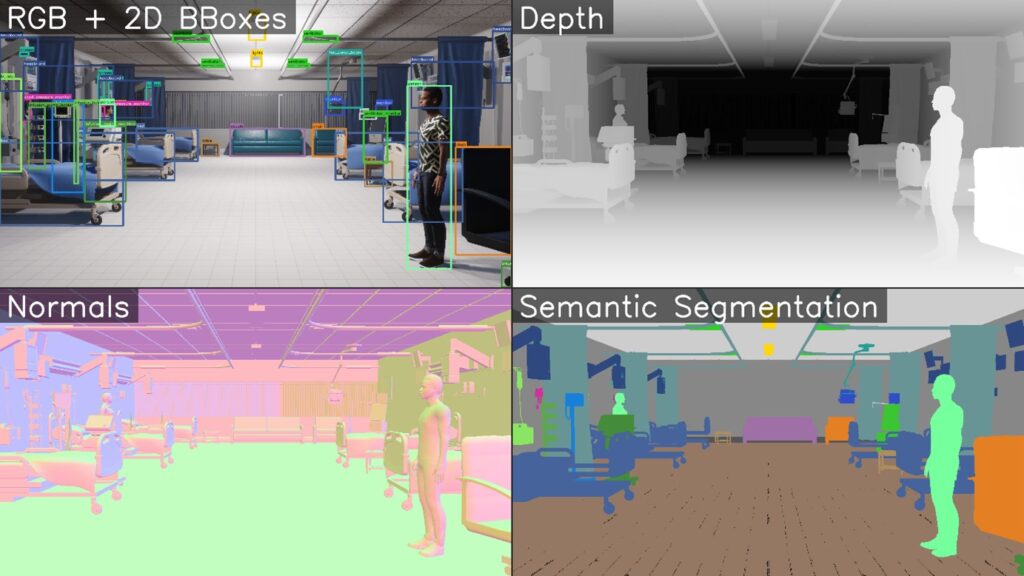
A key research aspect is the use of simulation-based modeling and synthetic data generation to train AI systems for clinically relevant objects, patient states, and situations that are difficult to capture in real-world datasets. This reduces the need for extensive data collection in sensitive clinical settings while supporting the development of robust perception models.
Project goals and expected results
The STEWARINA project develops advanced perception and situation-awareness technologies for autonomous mobile robots operating in complex clinical environments. By combining AI-based scene understanding, multi-sensor integration, and simulation-driven development approaches, the project aims to improve the safety, reliability, and adaptability of robotic systems in hospitals.
Key objectives and expected outcomes include:
- Development of AI-based perception methods for recognizing people, medical equipment, and clinically relevant situations
- Integration of multiple sensor modalities and contextual environment knowledge for robust scene understanding
- Simulation-based generation of synthetic training data for efficient AI model training and validation
- Extension of an existing robotics platform with modular perception architectures tailored to healthcare environments
- Improved situational awareness enabling safe, adaptive, and reliable robot navigation in dynamic hospital settings
The Role of SETLabs
SETLabs Research contributes its expertise in artificial intelligence, modeling and simulation, robotics, and software-intensive systems to the STEWARINA project. Within the project, SETLabs focuses on AI-based perception methods, simulation-supported development workflows, and the integration of contextual scene understanding for autonomous robotic systems in healthcare environments.

Figure 1: Simulation-based training environment for generating synthetic data and developing AI perception models for autonomous robotic systems in hospital environments.
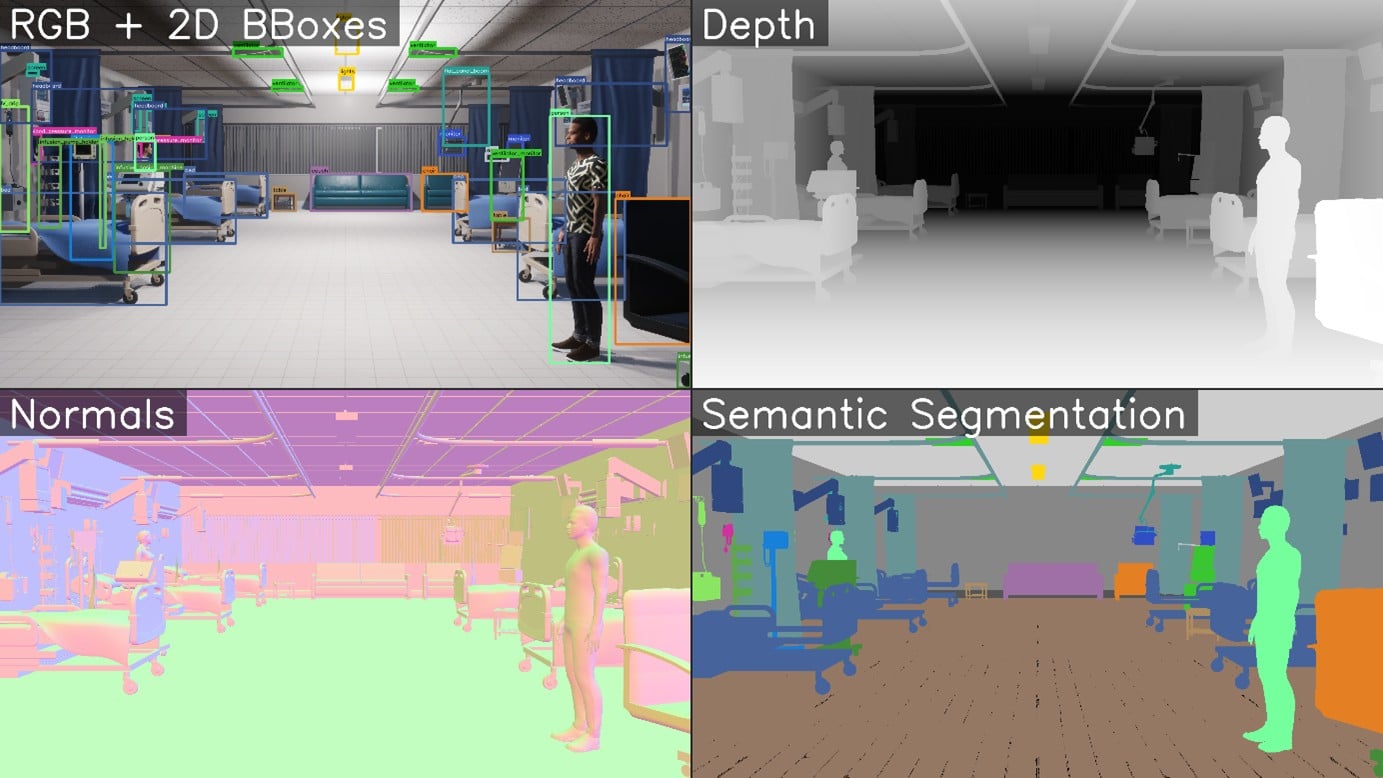
Figure 2: Multi-layer synthetic annotation pipeline for AI training in hospital environments.

Figure 3: Ontology-based knowledge representation framework (STEWARINA ontology) for autonomous clinical robotics, integrating spatio-temporal reasoning, human activity understanding, and contextual scene interpretation.
Funding: This project is funded within the COMET K2 Competence Centers for Excellent Technologies by the Austrian Federal Ministry for Innovation, Mobility and Infrastructure (BMIMI), Austrian Federal Ministry for Economy, Energy and Tourism (BMWET), the Province of Styria (Dept. 12) and the Styrian Business Promotion Agency (SFG). The Austrian Research Promotion Agency (FFG) has been authorised for the programme management.